
OPEN AGENT SYSTEMS / OPEN SOURCE
Connect intelligence.
Evolve systems.
From a model call to systems that keep doing real work. Open Agent Systems builds toward open foundations for the AI-native era.
Connect models, agents, tools, data and compute so independent capabilities can work together and innovation can reach real use.
From one intent to coordinated work.
APPLICATIONS / Development · Operations · Automation
Six connected domains with shared governance, supporting development, operations and business automation.
Choose and compose model access, proxies and inference services.
OUR VISION
From individual capabilities to shared foundations.
Developers should be able to choose models, compose capabilities and control execution. Teams should turn their work into reusable assets, while independent projects evolve together through open interfaces.
OPEN SYSTEMS / CAPABILITY MAP
The shared foundations of AI-native systems.
Start with application value. Coordinate intelligent execution. Ground it in knowledge and reusable assets, with governance and continuous improvement throughout.
APPLICATIONS
BUILD & EXECUTE
KNOWLEDGE & REUSE
CROSS-CUTTING
Applications drive demand · Shared capabilities enable delivery · Evidence drives improvement
Ecosystem plan and conceptual interaction. Intended capabilities and relationships, not shipped products or live telemetry.
Download architecture diagram (SVG) ↓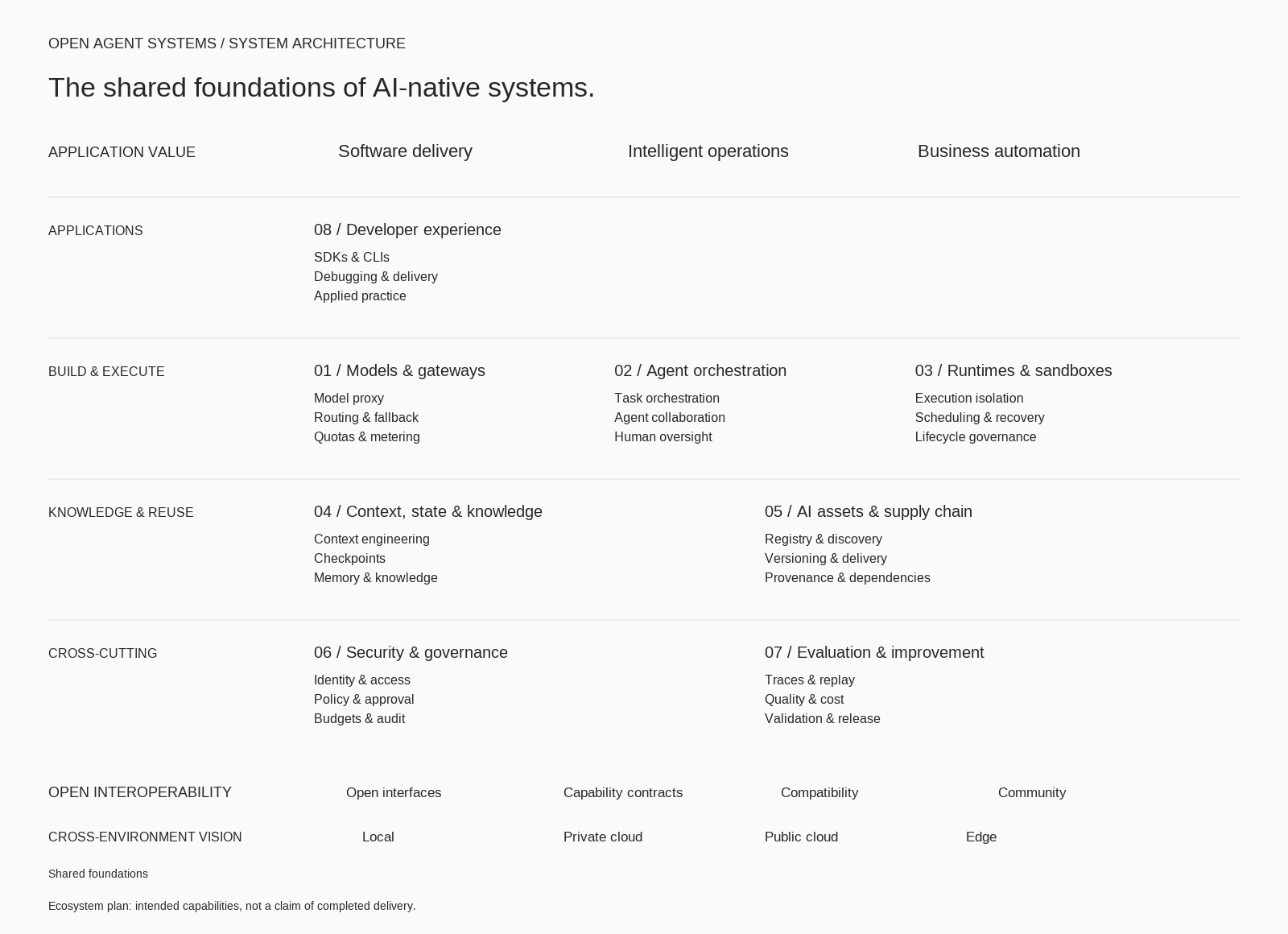
Make technical investment compound
As AI moves from answering questions to taking action, teams need reusable foundations, controlled costs and verifiable delivery. These are the outcomes we aim to support.
- Delivery
- Reduce repeated integration and environment setup so teams can focus on their work.
- Economics
- Connect model usage, task budgets and environment lifecycles to make costs visible.
- Trust
- Build permissions, execution evidence and result verification into workflows.
- Reuse
- Share skills, knowledge, templates and practices while preserving choice and portability.
From open components to a connected ecosystem
We expect the work to move from individual tools toward connected systems. Each step should build on working software and lessons from its users.
Select a direction to explore the work
Useful foundations
Build model access, execution, asset management and verification around real needs. Each component should stand on its own.
Real use and community feedback inform every stage.
This diagram describes our intended direction, not a release schedule or a statement of completed capabilities. Work in these areas may overlap; priorities will follow actual needs and available contributions.
How we approach the work
- Keep the boundaries clearPrefer small, composable capabilities with understandable interfaces.
- Make the work usableDocumentation, examples, and maintainability matter alongside implementation.
- Show what worksBe clear about what is available, what has been verified, and what is still being explored.
Participate
Have a use case, an integration problem, or an idea for the ecosystem? Tell us what you’re trying to do, what is getting in the way, and what you’ve already tried.
Organization-level suggestions are welcome in the community repository’s Issues. Contributions to individual projects will be handled in their own repositories when they are published.
Open a community issue